Research · AAAI 2024
Generator Assisted Mixture of Experts for Feature Acquisition in Batch
An approach to choosing which features to query in a batch under a fixed acquisition budget.
This work studies classification when only an initial subset of features is available and new features must be selected in a batch. We introduce GENEX, an algorithm for choosing which features to query under a budget constraint, then classifying from the available values.
Salient features
- A greedy algorithm to determine the features to acquire during training.
- Locality Sensitive Hashing for fast retrieval of the optimal feature subset at inference time.
- A mixture-of-experts classifier for a heterogeneous domain of feature subsets.
- A generator that produces a subset of the features to acquire, reducing queries to the oracle.
- Theoretical support and empirical verification for the greedy algorithm.
Problem setup
We use \(x \in \mathbb{R}^n\) for a feature vector and \(y\) for its classification label. Let \(\mathcal{I} = [n]\) be the feature indices, \(\mathcal{O} \subset \mathcal{I}\) the initially observed features, and \(\mathcal{U} \subset \mathcal{I} \setminus \mathcal{O}\) the features acquired by the algorithm. A generator produces \(\mathcal{V} \subset \mathcal{U}\) to save query cost; the remaining features in \(\mathcal{U} \setminus \mathcal{V}\) are queried. We use \(p(x'[\mathcal{V}]\vert x[\mathcal{O}])\) as a stochastic generator and \(h(\bullet)\) as the classifier.
\[loss(h,p,U,V\vert O) = \mathbb{E}_{x'[V] \sim p(\bullet\vert x[O])} l(h(x[O \cup U \setminus V] \cup x'[V]))\] \[min_{h,p,V_i,U_i} \sum_{i \in D} loss(h,p,U_i,V_i\vert O_i)\]subject to the budget constraint \(\vert U_i \setminus V_i \vert \le q_{max}\) for each point \(i \in D\), the dataset.
Proposed approach
Data partitioning
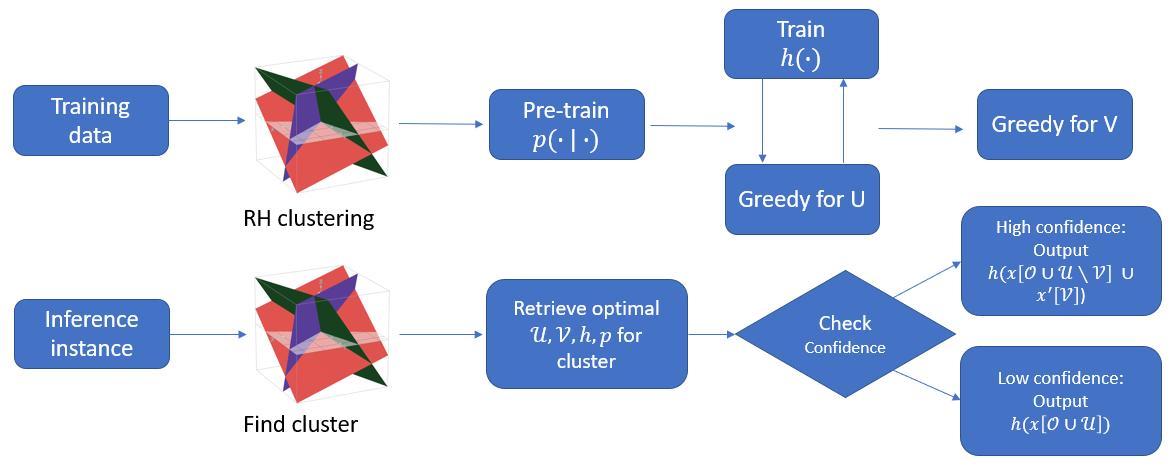
To reduce the heterogeneity of feature subsets available for classification, we cluster the data using the observed features \(x[\mathcal{O}]\). We perform random-hyperplane (RH) clustering, which provides good bucket balance and a per-instance objective.
We further use the data partitions to reduce the number of optimization variables. This is done by assigning the same optimal \(\mathcal{U}, \mathcal{V}\) for data points in the same bucket. Moreover, the optimal value of \(\mathcal{U}, \mathcal{V}\) is determined by a greedy algorithm on the training set. During inference, we locate the cluster corresponding to the test instance and use the optimal \(\mathcal{U}, \mathcal{V}\) for that cluster.
Mixture models
We deploy mixture models on the partitioned data by training an independent classifier for each cluster. This addresses feature-space heterogeneity and reduces inter-instance coupling of the optimal \(\mathcal{U}\) and \(\mathcal{V}\) subsets.
Training and greedy algorithm
We first pretrain the generator to model arbitrary conditionals on the data in a \(\beta\)-VAE style. We then alternate between training the classifier and greedily constructing the optimal \(\mathcal{U}\). We use a surrogate objective that is a function of \(\mathcal{U}\), decoupling it from \(\mathcal{V}\).
\[F(h,p,U\vert O) = \Delta(U) l(h(x[O \cup U]), y) + (1-\Delta(U)) l(h(x[O] \cup x'[U]), y)\]The objective \(F(h,p,U\vert O)\) is a linear combination of the loss from using oracle values for \(\mathcal{U}\) and generating the full subset \(\mathcal{U}\), weighted by the uncertainty of the generator \(\Delta(U)\). The greedy algorithm greedily adds elements to \(\mathcal{U}\) while the surrogate objective decreases.
We subsequently employ a greedy algorithm to construct \(\mathcal{V} \subset \mathcal{U}\), adding elements while the overall objective decreases.
Inference
During inference, the test instance is clustered using \(x[\mathcal{O}]\). The optimal \(\mathcal{U}, \mathcal{V}\) subsets and the classifier \(h\) for this cluster will be used subsequently. The generator is used to generate \(x'[\mathcal{V}]\) conditioned on \(x[\mathcal{O}]\). We also query the values of \(x[\mathcal{U} \setminus \mathcal{V}]\). Then, we perform classification using \(h(x[\mathcal{O} \cup \mathcal{U} \setminus \mathcal{V}] \cup x'[\mathcal{V}])\). If the confidence of the classifier is low, we subsequently query \(x[\mathcal{V}]\) and classify using \(h(x[\mathcal{O} \cup \mathcal{U}])\).
Results
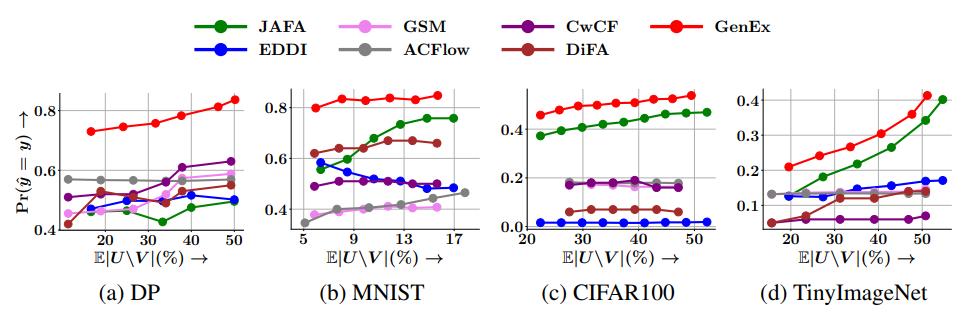
We plot accuracy against query cost for four datasets and compare GENEX with RL-based and greedy baselines. The experiments show a significant accuracy gain over the state of the art.
Contacts
For questions or suggestions, contact Vedang Asgaonkar, Aditya Jain, or Abir De.